Wednesday, May 12, 2010

Phil Heyes GOYH to The Local Government Ombudsman ... released under FoI


FoI Government Office for Yorkshire and Humberside to the Local Government Ombudsman re: CPZs


Released under FoI.


Department for Transport plays Pontius Pilate ...

The DfT claim that it 'does not have the administrative resources' to censure local authorities so it is up to 'campaign groups' and others to hold councils to account.

So, we have civil servants fully aware that councils are breaking the law yet choosing to do nothing. They hold information and by failing to disclose this are exposing individuals to the risk of a loss.

I do believe that there is legislation to cover that ... and perhaps members of the legal profession will now start to take a close interest. The complainant to the DfT who received the response had brought to the attention of the officers of the DfT illegality and misconduct by a local authority.

However, the gentleman concerned is not just an ordinary motorist. He is a Traffic Order Consultant and a former senior officer of the Metropolitan Police, responsible for introducing Decriminalised Parking Enforcement into London in the 90's.

I am sure that the press will wish to know more ...

Another drafting blunder by the Department for Transport leads to breaches of the Data Protection Act

... another iceberg spotted.

It was mentioned at the time that the Traffic Management Act 2004 had been ill-conceived and there had been little proper consultation. The Operational Guidance similarly had been pulled together in a rush and dropped on local authorities toes just weeks before the legislation came into effect.

Now we can reveal a major blunder by the draftsmen which has compromised local authorities who may now have breached the Data Protection Act by acquiring data from the DVLA to which they weren't entitled and the DVLA for releasing data which they weren't entitled to release.

The 'Current' and 'Proposed' content can be seen below ...


The issue is quite simple.

When a PCN is issued there is a period of 28 days which MUST expire before a Notice to Owner can be issued.

The current drafting gives councils an illegal 'head start' on acquiring keeper details, in conflict with the legislation.
  • The PCN, if attached to a vehicle, can be removed by the driver who may or may not be the registered keeper and who may decide to pay within the 28 days … perhaps to avoid the Registered Keeper being aware.

  • However, in law the Notice to Owner (and therefore the keeper details) CANNOT be requested until after the 28 day period has expired because the law does not permit a Notice to Owner to be issued before then. The Guidance is in conflict with the law.
  • Because the Registered Keeper is responsible in law any attempt to acquire such details prior to the 28 days will constitute procedural impropriety.

The Guidance gives local authorities a ‘head start’ but this creates a breach of the Data Protection Act because the keeper may be provided details of the movements of the driver of the vehicle. This ‘sharing’ of data will constitute an offence. I am sure the ICO will wish to comment on the implications under DPA

BUT
the big blunder is the fact that any local authority who has acquired the data early will be guilty and the PCN will have to be cancelled AND, for those who have paid, monies refunded.

A simple FoI will reveal the extent but I would anticipate that the majority of councils would have done it and with £1.3bn PCNs a year this will run into tens if not hundreds of £millions.

Perhaps this new Government will consider a shake-up of the Department responsible for yet another shambles. Quite clearly Captain Smith has not been control of this ship as another iceberg approaches.
The same draftsmen seem to have forgotten that at Annex E in the same guidance they remind local authorities to comply with TSRGD 2002 AND that CPZs should be no bigger than a dozen streets!

The leaked document is shown below in full ...


Another PATAS decision supporting strict compliance with the law

Yet again we have a PATAS adjudication which confirms that there are mandatory signing requirements.
Well done to Ian Osang for his dogged determination to expose this injustice.
My question to Waltham Forest council highway officers is "You are aware that the signing at this restriction appears not to be fit for purpose given the number of motorists receiving penalties. What action have you taken to address or rectify this?"

WALTHAM FOREST: Motorist claims council could owe thousands after appeal victory
Tuesday 11th May 2010
By Sian Harrison »

A MOTORIST who won an appeal against a penalty notice for an "illegal" right turn claims the council could be forced to pay out thousands of pounds.

Ian Osang was given the penalty charge notice (PCN) after being photographed by one of the council's mobile camera cars turning right from Lea Bridge Road into Essex Road in June last year - a manoeuvre council enforcement officers said was illegal because of a sign fixed near the junction.
However, following an appeal to the Parking and Appeals Traffic Service (Patas), the penalty has been ruled invalid on the grounds the sign is in the wrong place.
Mr Osang, of Campus Road, Walthamstow, said he now believes the council may have to refund motorists who have been given PCNs for the same contravention at that junction.
He said: “It was patently obvious that this penalty had no legal validity, so it was reassuring to be vindicated.
“The implication of this decision is the council have now got to refund thousands of pounds.”
The ruling from Patas states the sign indicating there is no right turn allowed is opposite the no entry signs at the junction - not opposite the entrance to Essex Road as it should be.
Mr Osang initially raised his objection to the PCN with the council in July last year, but he referred the matter to Patas in October after the council insisted the notice was valid.
Having done his own investigation, the 42-year-old accountant found there were 2,313 PCNs issued at that junction during the past 12 months, which equates to £138,780.
He added: “It is a point of principle. Although the fine was only £60, it was clear there was no legal validity to it.
“People are now entitled to have a refund for any notice that has been issued at this junction.”
Mr Osang is now considering taking legal action against the council to compensate him for the time he has spent fighting the notice.
The Guardian is awaiting a comment from the council.

Tuesday, May 11, 2010

CPZ Documents released under FoI ...

I will make no comment and let the content of these recently acquired documents speak for themselves.
More will follow.
What must be remembered is that there are documents relating to CPZs which the Department for Transport refused to disclose to Lord Lucas under the Freedom of Information Act.

Stephen Sauvain QC, mentioned below, also represented Sunderland City Council at my first parking ticket adjudication. The appeal was against a handful of £60 parking tickets and the Council brought in the country's 'expert' to handle a simple appeal (and then for further advice) at a cost to Sunderland ratepayers now believed to run into six figures.


Proper fair parking enforcement ... it can be done

Credit where credit is due and here is one council who is getting it right ... and has recognised that they are providing a service. Well done Chorley.

SUCCESSFUL PARKING CONTRACT EXTENDED
By Karenh2009
Monday, May 10, 2010, 12:27

A FRIENDLY approach to parking in Chorley that has seen the number of penalty tickets drop by more than a third is set to stay saving taxpayers an extra £10,000 per year.

Civil Enforcement Officers monitoring the town centre car parks for Chorley Council in their red uniform.

After a successful first year in which complaints and penalty tickets have reduced dramatically Chorley Council will be extending its contract with Legion Group for at least four years.

Councillor Peter Goldsworthy, Leader of Chorley Council, said: “Since we took back control of parking enforcement in our town centre car parks we have noticed a real improvement in the way things have been done and that is down to our partnership with Legion Group.

“We know that if someone has a bad experience on one of our car parks they may not come back to visit but if we get it right it will send out a really positive message that Chorley is a friendly place for shoppers.”

A new system of parking enforcement and administration was introduced in September when Chorley Council pulled out of the controversial Parkwise scheme.

The Council’s 13 town centre pay-and-display car parks are now monitored by the Legion Group, with IT company Chipside carrying out the back office administration.

Since the change penalty tickets on the council’s car parks have reduced by 38 per cent with the number of complaints also falling.

“We’re delighted that we will be continuing to work with Legion and the new contract will save us an extra £10,000 per year on top of the £25,000 annual savings since we took the service in-house,” said Coun Goldsworthy.

Tony Goddard, Head of Parking for Legion Group, said “We are proud of the reputation we have for the provision of a friendly, customer orientated parking service and are delighted to be working with Chorley Council for the next four years.”

On street parking, this covers all parking restrictions and regulations outside of the town’s pay-and-display car parks, remains under the control of Lancashire County Council.

People can easily identify the different Civil Enforcement Officers – the ones working for Chorley Council and monitoring the car parks wear a red uniform and those working for Lancashire County Council wear blue.

For more information about parking visit www.chorley.gov.uk/parking.

Sunday, May 09, 2010

Was the definition of a CPZ met? You decide ...

A CPZ is defined at Regulation 4 TSRGD 2002 as:
"controlled parking zone" means -
(a) an area -
(i) in which, except where parking places have been provided, every road has been marked with one or more of the road markings shown in diagrams 1017, 1018.1, 1019 and 1020.1; and

(ii) into which each entrance for vehicular traffic has been indicated by the sign shown in diagram 663 or 663.1;

The pictures below represent a sample of the evidence provided to NPAS Adjudicator Andrew Keenan at the hearings in Sunderland in 2007. They indicate areas of unrestricted highway, non-compliant bays and restrictions which are not contained in the Regulation 4 definition.

He considered these 'trivialities' in his decision.


What did the House of Commons Transport Committee think about CPZs?


PATAS Chief Adjudicator describes Controlled Parking Zones (CPZs) as 'archaic.'

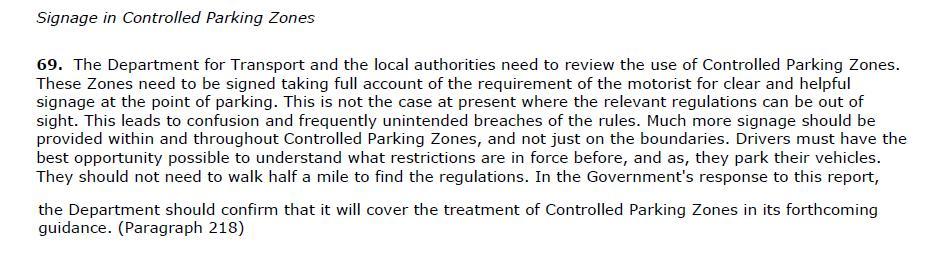
The House of Commons Transport Committee in 2006 recommend that ... 'The Department for Transport (DfT) and local authorities need to review the use of CPZs.'


The Committee also insisted that the Government response confirmed that it would deal with the issue of CPZs in its forthcoming guidance. The Government's response (left) is clear and unequivocal.

The Operational Guidance published two years later could also not have been clearer and for ease of reference I will once again publish Annex E5 below:


Red Routes invalidate CPZs says Department for Transport

This document was released under the Freedom of Information Act and is self-explanatory.

In 2009 Westminster City Council finally took heed of the advice ... five years after being informed.

Other London Boroughs have yet to act.

Definition of a CPZ ... and the implications of non-conformity

DEFINITION OF A CONTROLLED PARKING ZONE
… and the implications of the Neil Herron / Parking Appeals Ltd. challenge.

At the outset of the decriminalised parking process, the then relevant 1994 TSRGD provided a variable definition of a Controlled Parking Zone.

The definition was provided by the Secretary of State for Transport in his direction 23(3) within TSRGD 1994:

(3) In this direction and direction 24, "controlled parking zone" means either
(a) an area
(i) in which, except where parking places have been provided, every road has been
marked with one or more of the road markings shown in diagrams 1017, 1018.1,
1019 and 1020.1; and
(ii) into which each entrance for vehicular traffic has been indicated by a sign shown in
diagram 663 or 663.1;


Being a ‘Direction’ of the Secretary of State for Transport, the constraints relating to the provision of ‘Controlled Parking Zone’ (CPZ), primarily that all roads must either have prescribed parking bays or, they are to be controlled by one of the designated parking restrictions were variable, under the powers granted to the Secretary of State for Transport by the Road Traffic Regulation Act 1984 (the Act).

1 By definition should any area of highway be uncontrolled, there could not be a CPZ unless of the Secretary of State for Transport provided approval by site or area specific amendment to his direction.

2 It is my understanding that in the 2002 revision of TSRGD however, both the powers of the Secretary of State for Transport in defining and modifying what is or is not a CPZ have been removed.

The requirements for the provision of a CPZ have now been incorporated into Regulations approved by Ministers, to be precise it is now contained within Regulation 4 of the Traffic Signs Regulations and General Directions 2002

To quote: (we are only dealing with type (a) CPZs)
"controlled parking zone" means ¬
(a) an area -
(i) in which, except where parking places have been provided, every road has been
marked with one or more of the road markings shown in diagrams 1017, 1018.1,
1019 and 1020.1; and
(ii) into which each entrance for vehicular traffic has been indicated by the sign
shown in diagram 663 or 663.1;


It is my firm understanding and conclusion that this current Regulatory definition of a Controlled Parking Zone (CPZ) is not variable unless there is a change to the Statutory Instrument, that the pedantic requirements are precisely constrained and there is no legislative or legal latitude for either error or flaw.

Extract from a Report prepared for Parking Appeals by Signing Consultant and Accredited Expert Witness Richard Bentley of RMB Consulting.

Therefore, if any area of highway is not marked with a single yellow line, double yellow line (or single or double kerb blips) or a parking space (which may be a pay and display bay, resident’s bay, disabled bay, loading bay etc.) then a Controlled Parking Zone cannot exist in law because of the precise constraints of the definition of a CPZ in Regulation 4 of TSRGD 2002.

The problem with this strict definition is that it does not take into account areas of highway within the CPZ which could be marked with School Keep Clears, Taxi Ranks or Bus Stop Clearways which are not parking spaces.

Furthermore, if any of the parking spaces do not comply with the strict and pedantic requirements of diagrams 1028.4 / 1028.3 / 1032 etc. then they too are areas of uncontrolled highway.

If the CPZ falls the the restrictions at each location therefore MUST be correctly signed in accordance with TSRGD 2002 to still be enforceable.

- A double yellow line can be enforced 24 hours a day seven days a week and therefore
remains unaffected.

- A parking space correctly signed (with upright plates showing the times of operation will
be similarly unaffected).

The main ‘casualty’ therefore is the single yellow line. If, the CPZ does not exist by virtue of the fact that there are areas of uncontrolled highway contained therein (School Keep Clears, Bus Stop Clearways, road studs, non-compliant parking spaces), then the single yellow line must be accompanied at each location by the upright plate (Diagram 639 TSRGD 2002 ... left) to be enforceable because the CPZ entry plates (Diagram 663 TSRGD 2002 ...top of page) no longer have any effect (CPZ Entry Signs can only be erected to give effect to a CPZ)

Implications
The implications for local authorities across the country are enormous and potentially fatal to every Controlled Parking Zone in the country.
Initially CPZs were intended for small areas to allow the reduction in street clutter (and remove the necessity for the repetitive ‘639’ plates showing the times of operation of the single yellow line restrictions. The times of operation would be shown on the entry plates.

This was reaffirmed by the most recently published Operational Guidance to Local Authorities: Parking Policy and Enforcement especially at Annex E which states:


Local authorities however have seen CPZs as ‘cost saver’ and by simply erecting two 663 CPZ Entry Plates at every entrance to the zone the zones got bigger and bigger to the point that most motorists would not have a clue when they passed an entry plate and when the restriction applies. This all leads to increased confusion … and increased fine revenue for councils.

The problem is that because the zones got bigger so did the amount type of restrictions contained within … and because they were areas bigger than the legislators had intended they also contained Taxi Ranks, zig-zags, Bus Stop Clearways, road studs and unrestricted highway etc. not contained in the strict definition of a CPZ in Regulation 4.

Added to this, many councils have made fundamental errors with regard to the correct signing of the parking spaces and many have used unlawful hybrids (combinations of 1032 / 1028 series … and the Department for Transport have confirmed that such ‘hybrid’ bays are unlawful).

The Department for Transport has admitted (Roger Mackintosh in response to a question from Neil Herron at the Institute of Highways Engineers Conference in Loughborough September 20th 2007) that it is aware of the problem it has created with Regulation 4 and that are considering amending or re-drafting the legislation, but until they do it looks like that there may not be a valid Controlled Parking Zone anywhere in the country.
It must be noted that for a simple parking ticket case against a former market trader the defendant and interested parties are represented by the country's leading lawyers and the Treasury Solicitors have made submissions on behalf of the Secretary of State. The DfT's position seems to be at odds with their previous statements:

The extract below is from a presentation to local authorities and the Chief Adjudicator by officials from the DfT in 2004 (obtained under FoI)


Saturday, May 08, 2010

Consultation between the DfT, Councils and the adjudication service

This document was obtained under FoI and relates to a meeting at the DfT HQ between officals, councils and the adjudication service in 2004 two years after the publication of the Traffic Signs Regulations and General Directions 2002 ... which defines a CPZ at Regulation4.

The definition of a CPZ is at the centre of the Judicial Review currently before the High Court in a case which is being defended by the Parking Adjudicator, Sunderland City Council AND the Treasury Solicitors.

Tuesday, April 27, 2010

Sunderland City Council ... 'A Nice Little Earner ...'

'A nice little earner?'

'Entrapment?'

This is what passes for parking enforcement in the biggest city between Leeds and Edinburgh.

The people of Sunderland were disgusted at the negative portrayal of THEIR city in the BBC documentary which exposed fraud, bribery, corruption and incompetence.

As the High Court case approaches and the investigations by various agencies continue the penny may well start to drop that paranoid collective myopia is only a delusional, short-term, short-sighted solution.

Question to the elected members who bear FULL responsibility has to be ...'What price will YOU be prepared to pay?'

Check it out here as to what happens when elected members get it badly wrong. Remember that ALL the councillors in Sunderland cannot claim that they didn't know while collecting their allowances.

Who was the Council Officer who lied to the press to cover up the failings of Sunderland City Council?

As the net closes on the criminality surrounding Sunderland City Council's parking enforcement regime, the elected members who have failed to act at every twist and turn of this drama are now desperately consulting their own lawyers to ascertain what is the true extent of their own personal liability.
Sources reveal that they are in a state of panic as any liability insurance does not cover them in the event of criminality or recklessness. Fat Cat council officers have been allowed to retire or leave post while serious investigations are pending. Lesser mortals have not been afforded the same luxury.
However, not one councillor will be able to claim the excuse 'we didn't know' as they have been copied in to every email and some have even been served at home with full bundles of documentary evidence.

Despite being fully informed of the illegal actions of their council officers over the past 10 years they have failed to act. Every one of the acts and omissions have been fully documented and held on the public record. The gathering storm of public opinion will not accept the cries of 'we didn't know, we didn't understand.'

You took the money you accepted the responsibility.


With handsome remuneration as an elected official from the public purse comes REAL responsibility. Responsibility that requires investigation and accountability no matter how unpalatable the task, no matter how unpalatable the consequence.

The elected officials of Sunderland City Council have failed the electorate despite overwhelming evidence of malpractice and misfeasance they have allowed officers to mislead and deceive ... and then rewarded the self same officers handsomely from the public purse whilst the accounts are outstanding and a fraud investigation is pending, and other matters are before the High Court.


Perhaps the officer maligned by the deliberate deception above and left will have an attack of conscience or will he be prepared to take the hit for the failings of others? He knows where many of the bodies are buried and he also knows that the Department for Transport knows too.

Who is being protected?

Will the good guys allow the rats to leave the ship with impunity?

Society is only as good as the people who live amongst it and those who are prepared to stand up and be counted. As the press and media interest gathers and the national implications grow the question is 'Who is prepared to take the blame ... the guilty or the naive?'

Sunderland City Council Officers Lie to the Sunderland Echo ...

The statement to the Sunderland Echo seriously trobled Government Office officials.

They did not want to be party to a 'falsehood.'

Sunderland Council officers have been allowed to 'leave post' with impunity. Perhaps the elected members do not realise that they will carry FULL responsibility.

More to follow ...

CPZ Test Case Required ... DfT says...

More documents released under the Freedom of Information Act 2000.

This meeting was not held in Sunderland as Sunderland City Council officials did not want the DfT to be aware of the systemic failings of their parking enforcement regime. The meeting was held in Wellbar House in Newcastle.

More papers will be revealed in the coming days.

It will also be revealed that, since 2005 Sunderland City Councillors were made fully aware of the behaviour of their council officers yet turned a blind eye and failed to initiate an independent, external investigation.

Members have today been informed of serious allegations made to the Traffic Penalty Tribunal by a member of the Sunderland business community. He .won his case against the City Council

Parking Enforcement in Sunderland ...

To assist everyone with understanding why someone would risk everything to challenge a parking ticket ... this is how it started.


Monday, April 26, 2010

Department for Transport Presentations on CPZs

This presentation was given in 2007 by Roger Mackintosh to the Institute of Highways Engineers.

Both were obtained under FoI.


This presentation was provided with Papers relating to a Department for Transport seminar on CPZs in 2004 and given by Kitty Vernon.


Sunderland created their CPZ in 1968 ...

... but cannot find any evidence!


and they told the Department for Transport that ALL lines, signs and Traffic Regulation Orders were correct and in force when they applied for Decriminalised Parking Enforcement (DPE)Powers in 2003. Below is an extract from their own internal report The DPE: Post Implementation Review:

Blog Archive


only search Neil Herron Blog