
25 streets and the majority of residents opposed yet look at the attitude of the council officers below.
Controlled parking zone one step away from approval
Oxford Mail
Monday 22nd March 2010
COUNCIL officers have recommended a proposed £297,000 controlled parking zone (CPZ) in the Magdalen Road area of East Oxford should go ahead, despite opposition from residents.
Oxfordshire County Council’s cabinet member for transport, Rodney Rose, will decide whether to approve the residents’ parking scheme on Thursday. If passed, the restrictions will come into force in spring next year.
From November to January, the council sent questionnaires to all 1,726 homes in the Magdalen Road area, and 511 packs to every property in Iffley Fields, which will not now be included in the scheme.
The council received 565 responses.
In the proposed CPZ area of 25 roads, 61 per cent of respondents objected to the proposals and in Howard Street, on the edge of the proposed zone, 91 per cent objected.
In Iffley Fields, 54 per cent of respondents wanted their area excluded from the CPZ.
Consultation over the proposals has been going on for more than two years and campaigns have been organised on both sides of the debate.
Supporters of the scheme hope it will end parking problems and stop commuters leaving their vehicles in the road.
Head of transport Steve Howell wrote in the report: “Although the scheme is obviously controversial, officers consider that the benefits, in terms of the scheme’s overall objectives, would outweigh the ‘disbenefits’ raised by respondents.”
Cllr Rose said: “We don’t put in CPZs for the fun of it. If people want them we do a proper consultation and hopefully the majority will get what they asked for.”
Showing posts with label CPZs. Show all posts
Showing posts with label CPZs. Show all posts
Monday, May 31, 2010


Friday, May 28, 2010
Are zones effective or unwieldy?
The extract below comes from:
THE JOINT REPORT OF THE PARKING ADJUDICATORS FOR ENGLAND AND WALES
APRIL 2008 TO MARCH 2009
The Department for Transport Traffic Signs Review
The Traffic Signs Regulations and General Directions 2002 (S.I. 2002 No.3113)
apply to both Wales and England. In consideration the next version of TSRGD
English Ministers decided it was opportune to undertake a review of road signs,
with particular attention to whether it is necessary for there to be so much
prescription, the impact of road signs on the environment, and to reconsider
precisely how much signing is required to make contraventions of traffic orders
enforceable.
A Steering Group was set up which includes a representative from
WAG as well as The Chief Adjudicator of the Traffic Penalty Tribunal, who has
also been asked to Chair the Enforcement Working Group.
It is crucial that there is full involvement from representatives from Wales,
because of the potential consequences of adopting different signing in England,
and the consideration of the impact of new ideas on sign that must be written in
two languages.
It is inevitable that considerable attention is being given to parking signs and
lines, with particular thought being given to the effectiveness of zones and
whether that principle should embrace more parking imperatives, such as
footway parking, or whether the entire concept of zones is too unwieldy and not
readily understood by motorists.
Following on from the initial meetings and setting up of the three working groups
research will be commissioned by the DfT to examine independently some of the
proposals under consideration.
There will be formal consultation, but the DfT welcomes all input from those who
have an interest or experience of signing. The British Parking Association (BPA)
Welsh Special Interest Group is also looking at the proposals that have been put
forward so far to ensure that considerations for Wales are kept at the forefront of
the Review.
THE JOINT REPORT OF THE PARKING ADJUDICATORS FOR ENGLAND AND WALES
APRIL 2008 TO MARCH 2009
The Department for Transport Traffic Signs Review
The Traffic Signs Regulations and General Directions 2002 (S.I. 2002 No.3113)
apply to both Wales and England. In consideration the next version of TSRGD
English Ministers decided it was opportune to undertake a review of road signs,
with particular attention to whether it is necessary for there to be so much
prescription, the impact of road signs on the environment, and to reconsider
precisely how much signing is required to make contraventions of traffic orders
enforceable.
A Steering Group was set up which includes a representative from
WAG as well as The Chief Adjudicator of the Traffic Penalty Tribunal, who has
also been asked to Chair the Enforcement Working Group.
It is crucial that there is full involvement from representatives from Wales,
because of the potential consequences of adopting different signing in England,
and the consideration of the impact of new ideas on sign that must be written in
two languages.
It is inevitable that considerable attention is being given to parking signs and
lines, with particular thought being given to the effectiveness of zones and
whether that principle should embrace more parking imperatives, such as
footway parking, or whether the entire concept of zones is too unwieldy and not
readily understood by motorists.
Following on from the initial meetings and setting up of the three working groups
research will be commissioned by the DfT to examine independently some of the
proposals under consideration.
There will be formal consultation, but the DfT welcomes all input from those who
have an interest or experience of signing. The British Parking Association (BPA)
Welsh Special Interest Group is also looking at the proposals that have been put
forward so far to ensure that considerations for Wales are kept at the forefront of
the Review.
How many councils have illegal CPZs? How many consultations were flawed?
Flawed consultations. Big, unwieldy CPZs. How many councils ignored Annex E of the Operational Guidance to Local Authorities on Parking Policy and Enforcement?
How many will pay the price for being reckless and indifferent towards their legal responsibilities. No-one is above the law and, as Justice Bean stated, when referring to the consequences of a local authority failing to comply:
" Let the heavens fall and justice prevail."
The High Court case has shone a very bright spotlight on the parking enforcement industry and council's behaviour in particular, especially when it comes to raising hard cash from enforcement. There is a great deal more to come ...
What must also be borne in mind is that Kingston Council were one of the four London Boroughs who added an unlawful credit card surcharge to their PCNs. That matter is also before the High Court in Camden v The Parking Adjudicator next month. The argument regarding the lawfulness of the credit card surcharge was ours and the Chief Adjudicator agreed with the point that this rendered the PCN unlawful.
Should Camden lose there will be far reaching consequences financially as they too will have been unjustly enriched and will have to refund the money.
 CPZ ruling could cost Kingston Council
Friday 28th May 2010
By Clare Buchanan »
This week, campaigner Neil Herron, is taking Sunderland Council to the High Court in a bid to abolish Britain’s Controlled Parking Zones (CPZs). Successful or not, the consequences could prove momentous to Kingston’s residents and roads.
Nearly a quarter of Kingston’s roads are marked as CPZs, and in 2009-10, 42,426 parking fines were issued in the borough.
Mr Herron argued that large CPZ, such as Kingston’s, are not only misleading and confusing for drivers, but also unlawful, resulting in fines which he argued were invalid.
He said: “The council has a duty to comply with the law, which states CPZs should be 12 streets or less. The bigger and bigger CPZs do not comply with the law.”
Without CPZs it is likely that the roads of Kingston would turn to chaos.
Councillor Dave Ryder-Mills said: “The main problems would be in the town centre, where originally CPZs were introduced to give protection to local residents so that they had a hope to park. They would be the ones who suffer, and there would no doubt be several knock-on effects.”
If Mr Herron is successful, the £2,030,413 raised by Kingston Council from parking fines in the year 2008-9, could be overturned, with local residents lining up to pocket the money.
Kingston’s current parking fines range from £30 to £100 per offence. While some have said these are necessary to enforce parking laws, others suggested the fines were stealth taxes for councils to make more money.
Mr Herron, who faces 39 penalty notices, has re-mortgaged his home, put his car, adorned with yellow lines and a personalised F1NED numberplate for sale and set up Parking Appeals ltd, in his one man bid to “decriminalise British parking”.
Mr Herron said: “Justice has to come. Where there is a heavy price we have to stand up and be counted, it is down to members of the public and local media to stop this disturbing state of affairs.”
Mr Herron’s sacrifices are just a small part of the funds necessary for the controversial test case, in his crusade to reform Britain’s parking laws.
Coun Ryder-Mills said: “Hopefully we have reached the limit with the CPZs, however there is always pressure on the next road and the next road to extend. Perhaps we will be able to start to make CPZs limited in time, for example Norbiton road is now limited between certain times.”
How many will pay the price for being reckless and indifferent towards their legal responsibilities. No-one is above the law and, as Justice Bean stated, when referring to the consequences of a local authority failing to comply:
" Let the heavens fall and justice prevail."
The High Court case has shone a very bright spotlight on the parking enforcement industry and council's behaviour in particular, especially when it comes to raising hard cash from enforcement. There is a great deal more to come ...
What must also be borne in mind is that Kingston Council were one of the four London Boroughs who added an unlawful credit card surcharge to their PCNs. That matter is also before the High Court in Camden v The Parking Adjudicator next month. The argument regarding the lawfulness of the credit card surcharge was ours and the Chief Adjudicator agreed with the point that this rendered the PCN unlawful.
Should Camden lose there will be far reaching consequences financially as they too will have been unjustly enriched and will have to refund the money.
 CPZ ruling could cost Kingston Council
Friday 28th May 2010
By Clare Buchanan »
This week, campaigner Neil Herron, is taking Sunderland Council to the High Court in a bid to abolish Britain’s Controlled Parking Zones (CPZs). Successful or not, the consequences could prove momentous to Kingston’s residents and roads.
Nearly a quarter of Kingston’s roads are marked as CPZs, and in 2009-10, 42,426 parking fines were issued in the borough.
Mr Herron argued that large CPZ, such as Kingston’s, are not only misleading and confusing for drivers, but also unlawful, resulting in fines which he argued were invalid.
He said: “The council has a duty to comply with the law, which states CPZs should be 12 streets or less. The bigger and bigger CPZs do not comply with the law.”
Without CPZs it is likely that the roads of Kingston would turn to chaos.
Councillor Dave Ryder-Mills said: “The main problems would be in the town centre, where originally CPZs were introduced to give protection to local residents so that they had a hope to park. They would be the ones who suffer, and there would no doubt be several knock-on effects.”
If Mr Herron is successful, the £2,030,413 raised by Kingston Council from parking fines in the year 2008-9, could be overturned, with local residents lining up to pocket the money.
Kingston’s current parking fines range from £30 to £100 per offence. While some have said these are necessary to enforce parking laws, others suggested the fines were stealth taxes for councils to make more money.
Mr Herron, who faces 39 penalty notices, has re-mortgaged his home, put his car, adorned with yellow lines and a personalised F1NED numberplate for sale and set up Parking Appeals ltd, in his one man bid to “decriminalise British parking”.
Mr Herron said: “Justice has to come. Where there is a heavy price we have to stand up and be counted, it is down to members of the public and local media to stop this disturbing state of affairs.”
Mr Herron’s sacrifices are just a small part of the funds necessary for the controversial test case, in his crusade to reform Britain’s parking laws.
Coun Ryder-Mills said: “Hopefully we have reached the limit with the CPZs, however there is always pressure on the next road and the next road to extend. Perhaps we will be able to start to make CPZs limited in time, for example Norbiton road is now limited between certain times.”
Tuesday, May 25, 2010
Press Reports High Court CPZ Case ... BBC Wear
 Neil Herron loses Sunderland parking battle at High Court
BBC Wear
25th May 2010
CPZ signs - at each end of a zone - are said to reduce street clutter
If you want to understand the significance of Neil Herron's defeat in the High Court you need to understand Controlled Parking Zones.
Don't all run away at once - you might be grateful next time you park in one.
Here is BBC Wear's handy guide to what they are, how they work and whether it's worth arguing about getting a ticket.
It all revolves around technicalities - technicalities that the judge called "trivialities".
Neil Herron, a former market trader from Sunderland, first came to public attention late in 2000 over the issue of metric measurement.
He helped his friend, Steven Thoburn, challenge a prosecution for selling fruit and vegetables in pounds and ounces, the offence being that he didn't have the metric scales required.
Technicalities or trivialities?
Since 2000 Mr Herron has transformed into something of a parking campaigner.
His current challenge - to Controlled Parking Zones, or CPZs - went all the way to the High Court.
Again, the issue revolved around a technicality.
An important technicality, said Mr Herron, since the result of infringement is "penal" and, he claimed, councils rely on the confusion to make money out of parking fines.
His over-strict interpretation of the rules, said Sunderland City Council and the Department of Transport, flew in the face of common sense.
On May 25 2010 Neil Herron lost his case and was told by the judge that it was "entirely based on technicality and utterly devoid of merit".
Neil Herron took his case to the High Court in London
What Mr Herron claimed:
The zone in Sunderland city centre is so large that it confuses drivers with its signs and is unlawful
The council relies on this confusion to make money out of parking fines
Penalty charge notices issued against him for parking on single yellow lines in the zone are unenforceable because, technically, there should be no road markings at all within a CPZ
In law, CPZs don't even exist but are "creatures of statute" and, in order to be enforceable, should comply with rigidly laid down road marking regulations
In order to meet the definition of a CPZ, there must be no road marking whatsoever within them, except signs indicating parking spaces and yellow lines
The presence of any other road markings at any point in the CPZ - including zig-zag lines or yellow bus stop clearways - render the entire CPZ invalid
Controlled Parking Zone rules
Entrance and exit signs show the hours during which all on-street parking is controlled
Parking is only permitted in designated parking spaces, the remainder of the kerbside is subject to yellow line restrictions
Single yellow lines prohibit parking during the hours of control, double yellow lines prohibit parking at any time
Some single yellow lines have signs showing different, usually longer, operation times
Parking during the permitted hours may be free or charged
What Sunderland City Council claimed:
Mr Herron's interpretation of road signage rules flies in the face of common sense
Legislators could not have intended the rules to be read thus
If this strict interpretation of the regulations was right a single pedestrian crossing marked on the road could invalidate a vast CPZ
The case could affect the legitimacy of parking tickets issued across the country in other "over-sized" CPZs and lead to thousands of motorists applying to have parking fines quashed
They vehemently dispute the accusation that local authorities rely on the confusion generated by the zones to make money out of parking fines
Their CPZ is being operated lawfully and drivers are being given the necessary information over where and when they can park
Technicalities or Trivialities?
The law is based on technicalities ... that is why the DfT spent so much effort drafting the Traffic Signs Regulations and General Directions in 2002 and the various Chapters of the Traffic Signs Manual.
Did the draftsmen of the Operational Guidance to Local Authorities on Parking Policy and Enforcement state that CPZs should be 12 streets or less just for the fun of it? Here is Annex E of that Guidance and it sets out the DfT's position explicitly.
So why is it that councils would wish to ensure that motorists didn't have adequate information as to the times of operation of single yellow lines in a CPZ (bearing in mind that the majority of single yellow lines in the country are 'out of force' for the majority of time in a 24 hour period)?
Could it be that there is more chance of a motorist being confused in a large CPZ and therefore issued with a PCN?
Could it be that greater confusion leads to more PCNs and a greater income?
It would be a brave Judge to publicly slap every council for 'giving it large' when it comes to CPZs. So, ask yourself what the DfT are prepared to do to ensure councils comply with their Guidance?
Their response was to throw all their resources at defeating the challenge by bringing in the Treasury Solicitors to argue that 'common sense' should be applied.
Is the British motorist afforded the same luxury of 'common sense' when a minute late back to a meter or an inch over a yellow line? Of course not and until the law is applied equally the fight for a fair deal for the motorist will go on.
Neil Herron loses Sunderland parking battle at High Court
BBC Wear
25th May 2010
CPZ signs - at each end of a zone - are said to reduce street clutter
If you want to understand the significance of Neil Herron's defeat in the High Court you need to understand Controlled Parking Zones.
Don't all run away at once - you might be grateful next time you park in one.
Here is BBC Wear's handy guide to what they are, how they work and whether it's worth arguing about getting a ticket.
It all revolves around technicalities - technicalities that the judge called "trivialities".
Neil Herron, a former market trader from Sunderland, first came to public attention late in 2000 over the issue of metric measurement.
He helped his friend, Steven Thoburn, challenge a prosecution for selling fruit and vegetables in pounds and ounces, the offence being that he didn't have the metric scales required.
Technicalities or trivialities?
Since 2000 Mr Herron has transformed into something of a parking campaigner.
His current challenge - to Controlled Parking Zones, or CPZs - went all the way to the High Court.
Again, the issue revolved around a technicality.
An important technicality, said Mr Herron, since the result of infringement is "penal" and, he claimed, councils rely on the confusion to make money out of parking fines.
His over-strict interpretation of the rules, said Sunderland City Council and the Department of Transport, flew in the face of common sense.
On May 25 2010 Neil Herron lost his case and was told by the judge that it was "entirely based on technicality and utterly devoid of merit".
What Mr Herron claimed:
- The zone in Sunderland city centre is so large that it confuses drivers with its signs and is unlawful
- The council relies on this confusion to make money out of parking fines
- Penalty charge notices issued against him for parking on single yellow lines in the zone are unenforceable because, technically, there should be no road markings at all within a CPZ
- In law, CPZs don't even exist but are "creatures of statute" and, in order to be enforceable, should comply with rigidly laid down road marking regulations
- In order to meet the definition of a CPZ, there must be no road marking whatsoever within them, except signs indicating parking spaces and yellow lines
- The presence of any other road markings at any point in the CPZ - including zig-zag lines or yellow bus stop clearways - render the entire CPZ invalid
Controlled Parking Zone rules
- Entrance and exit signs show the hours during which all on-street parking is controlled
- Parking is only permitted in designated parking spaces, the remainder of the kerbside is subject to yellow line restrictions
- Single yellow lines prohibit parking during the hours of control, double yellow lines prohibit parking at any time
- Some single yellow lines have signs showing different, usually longer, operation times
- Parking during the permitted hours may be free or charged
What Sunderland City Council claimed:
- Mr Herron's interpretation of road signage rules flies in the face of common sense
- Legislators could not have intended the rules to be read thus
- If this strict interpretation of the regulations was right a single pedestrian crossing marked on the road could invalidate a vast CPZ
- The case could affect the legitimacy of parking tickets issued across the country in other "over-sized" CPZs and lead to thousands of motorists applying to have parking fines quashed
- They vehemently dispute the accusation that local authorities rely on the confusion generated by the zones to make money out of parking fines
Their CPZ is being operated lawfully and drivers are being given the necessary information over where and when they can park
Thursday, May 20, 2010
Neil Herron on BBC's The One Show with Dominic Littlewood
Précis of the BBC 1 One show item (above) Thursday 13th May 2010
10 million parking Penalties Charge Notices are issued to drivers every year to a value of £328 Million !!
But 165 illegally-issued PCNs are cancelled every day which shows that there is a great deal wrong with the way parking enforcement is operated.
Neil Herron who won massive national support as one of the two “Metric Martyrs” has been campaigning for fairer parking enforcement for 5 years at a cost to himself of some £90,000
He is arguing in a High Court Judicial Review against some decisions of the Traffic Penalty Tribunal which, although claimed to be impartial and independent of the councils who enforce parking restrictions, is paid for by Manchester City Council from monies provided by all the enforcing councils.
The primary issue before the Court is the law governing the operation of Controlled Parking Zones (CPZs) to be found in many in cities where many of them are not set up and operated in accordance with the law.
Neil Herron’s argument is that the operation of all parking enforcement should be transparent, fair to motorists and lawful which it very often isn’t.
He argues that when councils issue PCNs, often for more that £100 t a driver returning just one minute late of being just one inch over a yellow line council itself must obey the law laid down by parliament themselves. Many councils have not been and are still not obeying the law.
Neil Herron is arguing the details of a CPZ in his home town of Sunderland where massive corruption in their parking enforcement was made public a couple of years ago. The only information on parking restrictions in a CPZ is shown on a notice as you enter the zone which is required not to enclose not more than 12 streets (otherwise drivers won’t remember the restrictions which aren’t shown anywhere else. The Sunderland CPZ is massively too big.
After he walked for ten minutes into the zone with the reporter they interviewed on camera five drivers who had all forgotten the details of the parking restrictions and agreed that operation of the CPZ was completely unfair.
The law on traffic signs is set out in the Traffic Signs Regulations and General Directions which sets out very clearly and easy to understand the law and rules that councils must follow before they can legally issue PCN.
Neil Herron has deliberately obtained about 120 PCN around the country to challenge them and expose the illegality of the enforcing councils. Most of them have been cancelled bu it is those that haven’t that are now being challenged in the High Court.
To fund his case he has had to remortgage his house. When asked if he was intimidated by the opposition to his campaign for lawful parking enforcement he replied the High Court is a scary place to be but the law is clearly on his side.
His Judicial Review is all about fairness to all of Britain’s motorists who have for many years been suffering what amounts to a stealth tax; he said it is about time someone stood up against it so that is exactly what he is doing.
The outcome of his case can affect millions of drivers and thousands of parking appeals that have been wrongly decided contrary to the law.
Monday, May 17, 2010
High Court Case Herron v The Parking Adjudicator
DATE OF CASE: Tuesday 18th May 2010 Start 10.30am
LOCATION: Royal Courts of Justice, The Strand, London
COURT NUMBER: 72
JUDGE: Mr. Justice Bean
CASE NUMBER: CO/9104/2008
IN THE HIGH COURT OF JUSTICE
QUEEN’S BENCH DIVISION
ADMINISTRATIVE COURT
BETWEEN
R on the application of
NEIL HERRON
First Claimant
PARKING APPEALS LIMITED
Second Claimant
And
THE PARKING ADJUDICATOR
Defendant
SUNDERLAND CITY COUNCIL (1)
PARKING AND TRAFFIC APPEALS (2)
TRAFFIC PENALTY TRIBUNAL (3)
NCP SERVICE LIMITED (4)
SECRETARY OF STATE FOR TRANSPORT (5)
Interested Parties
LOCATION: Royal Courts of Justice, The Strand, London
COURT NUMBER: 72
JUDGE: Mr. Justice Bean
CASE NUMBER: CO/9104/2008
IN THE HIGH COURT OF JUSTICE
QUEEN’S BENCH DIVISION
ADMINISTRATIVE COURT
BETWEEN
R on the application of
NEIL HERRON
First Claimant
PARKING APPEALS LIMITED
Second Claimant
And
THE PARKING ADJUDICATOR
Defendant
SUNDERLAND CITY COUNCIL (1)
PARKING AND TRAFFIC APPEALS (2)
TRAFFIC PENALTY TRIBUNAL (3)
NCP SERVICE LIMITED (4)
SECRETARY OF STATE FOR TRANSPORT (5)
Interested Parties
Saturday, May 15, 2010
CPZ High Court case on BBC's The One Show
... and for a simple overview of the High Court case see the BBC Six o' Clock News below (note this was first broadcast in 2008 BEFORE the High Court granted permission for a full hearing).
Thursday, May 13, 2010


Wednesday, May 12, 2010


Tuesday, May 11, 2010
CPZ Documents released under FoI ...
I will make no comment and let the content of these recently acquired documents speak for themselves.
More will follow.
What must be remembered is that there are documents relating to CPZs which the Department for Transport refused to disclose to Lord Lucas under the Freedom of Information Act.
Stephen Sauvain QC, mentioned below, also represented Sunderland City Council at my first parking ticket adjudication. The appeal was against a handful of £60 parking tickets and the Council brought in the country's 'expert' to handle a simple appeal (and then for further advice) at a cost to Sunderland ratepayers now believed to run into six figures.


More will follow.
What must be remembered is that there are documents relating to CPZs which the Department for Transport refused to disclose to Lord Lucas under the Freedom of Information Act.
Stephen Sauvain QC, mentioned below, also represented Sunderland City Council at my first parking ticket adjudication. The appeal was against a handful of £60 parking tickets and the Council brought in the country's 'expert' to handle a simple appeal (and then for further advice) at a cost to Sunderland ratepayers now believed to run into six figures.


Sunday, May 09, 2010
Was the definition of a CPZ met? You decide ...
A CPZ is defined at Regulation 4 TSRGD 2002 as:
"controlled parking zone" means -
(a) an area -
(i) in which, except where parking places have been provided, every road has been marked with one or more of the road markings shown in diagrams 1017, 1018.1, 1019 and 1020.1; and
(ii) into which each entrance for vehicular traffic has been indicated by the sign shown in diagram 663 or 663.1;
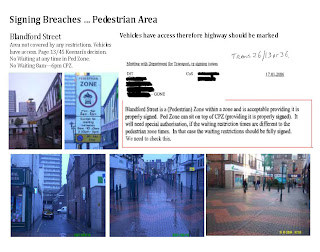
The pictures below represent a sample of the evidence provided to NPAS Adjudicator Andrew Keenan at the hearings in Sunderland in 2007. They indicate areas of unrestricted highway, non-compliant bays and restrictions which are not contained in the Regulation 4 definition.
He considered these 'trivialities' in his decision.


"controlled parking zone" means -
(a) an area -
(i) in which, except where parking places have been provided, every road has been marked with one or more of the road markings shown in diagrams 1017, 1018.1, 1019 and 1020.1; and
(ii) into which each entrance for vehicular traffic has been indicated by the sign shown in diagram 663 or 663.1;
The pictures below represent a sample of the evidence provided to NPAS Adjudicator Andrew Keenan at the hearings in Sunderland in 2007. They indicate areas of unrestricted highway, non-compliant bays and restrictions which are not contained in the Regulation 4 definition.
He considered these 'trivialities' in his decision.


What did the House of Commons Transport Committee think about CPZs?

PATAS Chief Adjudicator describes Controlled Parking Zones (CPZs) as 'archaic.'
The House of Commons Transport Committee in 2006 recommend that ... 'The Department for Transport (DfT) and local authorities need to review the use of CPZs.'
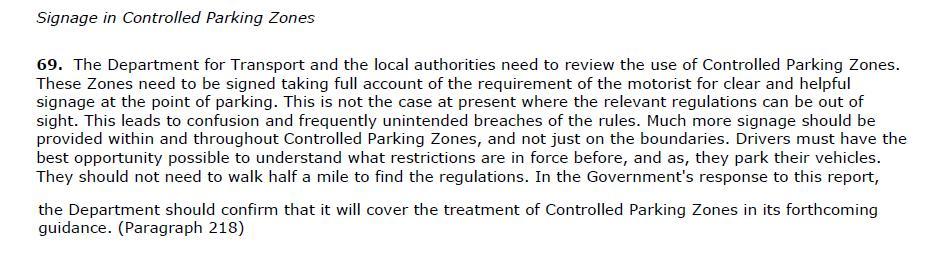 The Committee also insisted that the Government response confirmed that it would deal with the issue of CPZs in its forthcoming guidance. The Government's response (left) is clear and unequivocal.
The Operational Guidance published two years later could also not have been clearer and for ease of reference I will once again publish Annex E5 below:

Tuesday, April 27, 2010
Who was the Council Officer who lied to the press to cover up the failings of Sunderland City Council?
 As the net closes on the criminality surrounding Sunderland City Council's parking enforcement regime, the elected members who have failed to act at every twist and turn of this drama are now desperately consulting their own lawyers to ascertain what is the true extent of their own personal liability.
Sources reveal that they are in a state of panic as any liability insurance does not cover them in the event of criminality or recklessness. Fat Cat council officers have been allowed to retire or leave post while serious investigations are pending. Lesser mortals have not been afforded the same luxury.
However, not one councillor will be able to claim the excuse 'we didn't know' as they have been copied in to every email and some have even been served at home with full bundles of documentary evidence.
Despite being fully informed of the illegal actions of their council officers over the past 10 years they have failed to act. Every one of the acts and omissions have been fully documented and held on the public record. The gathering storm of public opinion will not accept the cries of 'we didn't know, we didn't understand.'
Despite being fully informed of the illegal actions of their council officers over the past 10 years they have failed to act. Every one of the acts and omissions have been fully documented and held on the public record. The gathering storm of public opinion will not accept the cries of 'we didn't know, we didn't understand.'
You took the money you accepted the responsibility.
With handsome remuneration as an elected official from the public purse comes REAL responsibility. Responsibility that requires investigation and accountability no matter how unpalatable the task, no matter how unpalatable the consequence.
The elected officials of Sunderland City Council have failed the electorate despite overwhelming evidence of malpractice and misfeasance they have allowed officers to mislead and deceive ... and then rewarded the self same officers handsomely from the public purse whilst the accounts are outstanding and a fraud investigation is pending, and other matters are before the High Court.
 Perhaps the officer maligned by the deliberate deception above and left will have an attack of conscience or will he be prepared to take the hit for the failings of others? He knows where many of the bodies are buried and he also knows that the Department for Transport knows too.
Who is being protected?
Will the good guys allow the rats to leave the ship with impunity?
Society is only as good as the people who live amongst it and those who are prepared to stand up and be counted. As the press and media interest gathers and the national implications grow the question is 'Who is prepared to take the blame ... the guilty or the naive?'
Monday, April 26, 2010
Department for Transport Presentations on CPZs


Controlled Parking Zones and the High Court case
 Just to give a flavour of the importance of the case to be heard before the High Court on the left is a document obtained under the Freedom of Information Act of a meeting which took place between officials from the Department for Transport, the Government Office for the North East and Sunderland City Council.
A lot of information on the reasons for the draftsmen of the TSRGD 2002 being so strict with the definition of a CPZ is still being 'witheld' but the content relating to the meeting is is pretty clear.
Sunday, July 19, 2009
A new peasant's revolt ... or justice on the horizon for the motorist?
 How to get revenge for your parking ticket
You can turn the tables on councils that play fast and loose with the law, says Philip Johnston
Published 19 Jul 2009
Daily Telegraph
Yes, I know: it's only a parking ticket. Perhaps I should not be in such a lather about it, but I am and I am not alone. Not by a long way. It is not that we cannot afford £60 (or £30 if we go quietly, which we won't). It is the sheer injustice of it.
This ticket was placed on our car not in the town centre or on a busy urban highway but in the street outside our house where we already pay £90 a year to park in a Controlled Parking Zone (CPZ), which a majority in our road voted against having in a referendum. We live in a quiet avenue in London with no problems of congestion or of obstruction.
Related Articles
A mess over illegal parking tickets
But the borough painted a confusing array of white and yellow lines everywhere, removing around a dozen spaces where cars used to be able to park. Near our home, the bay is so badly drawn that, in order not to obstruct a neighbour's access, we parked a few feet over the line, as everyone does and we have done many times.
A ticket was issued. We appealed to the local borough and they said: "We must advise that when using parking bays you must make sure your car is fully within the parking bay or space before you leave it. If it is beyond the end of a bay, straddling two bays or obstructing the clearway you may get a ticket even if you have paid to park, or have a valid permit allowing you to park."
When we pointed out that the lines were not easy to discern, and that if we parked within the lines the car would block a neighbour's access, we were told that "the law does not require that the yellow line must be in good condition. Enforcement can take place as long as the signage reasonably indicates a restriction".
It was this mention of the law that made me sit up. If they are going to quote the law at us, we will try to find out if they are observing it as well. If they are going to quibble about our car being a foot over an arbitrarily drawn line, let's see whether, in the myriad parking regulations, there is a legislative equivalent that we can irritate the life out of them with. If people are to be fined simply because their ticket has fallen off the windscreen, maybe the tables can be turned; and I know a man who can do turn them.
Neil Herron is a sort of latter day Wat Tyler leading a Peasant's Revolt against the parking tyranny that has gripped the land. A former fishmonger from Sunderland, he was a key figure in the celebrated Metric Martyr campaign a few years ago when his late friend Steve Thoburn, a fellow market stallholder, was fined for selling bananas by the pound. He has a sharp sense of injustice and now runs ParkingAppeals.co.uk, which specialises in fighting such cases – and winning them, too.
In fact, he is causing consternation in town halls across the land. In our case, Mr Herron advised that the CPZ may itself be illegal since it does not appear to have been correctly signposted. This could be true of residential parking zones around the country and he has a judicial review under way in which the Government is taking a direct interest because the implications are considerable: if CPZs are invalidated then millions of pounds in penalties may have to be returned.
Were this to happen, councils would have only themselves to blame. They simply became too greedy. CPZs were supposed to cover small areas of around 12 or so streets where there are legitimate parking worries, but they have spread across whole towns because they raise money. Parking has become a stealth tax. A fine is a punishment yet it is levied not through the criminal justice system but by way of a civil regime administered by local councils, many of whom seem not to think it matters whether they obey the regulations or not.
Last year in England, nearly four million tickets were issued, 250,000 more than in 2007 and a fivefold increase since 2001, the year when the decriminalised system (which has operated in London since the mid-1990s) began to spread across the country.
Thanks to Mr Herron, we have now discovered that the ticket we received is almost certainly invalid. Our borough, in common with several others, was making an additional charge for processing credit card payments. This has recently been ruled unlawful by the parking adjudicator because it adds an extra sum to what is a statutory penalty. The charge has been withdrawn; but our ticket was issued when it was still in place, which at least gives us something to argue with.
In the three months that our council operated this illegal scheme it issued tickets to the value of £500,000. These may have to be refunded. Other boroughs face paying back millions.
It serves them right – but in the end, of course, it will be the council taxpayer that suffers, so we will pay anyway. It should come out of the pockets of the people who played so fast and loose with the laws they expect the rest of us to follow.

Subscribe to:
Posts (Atom)


